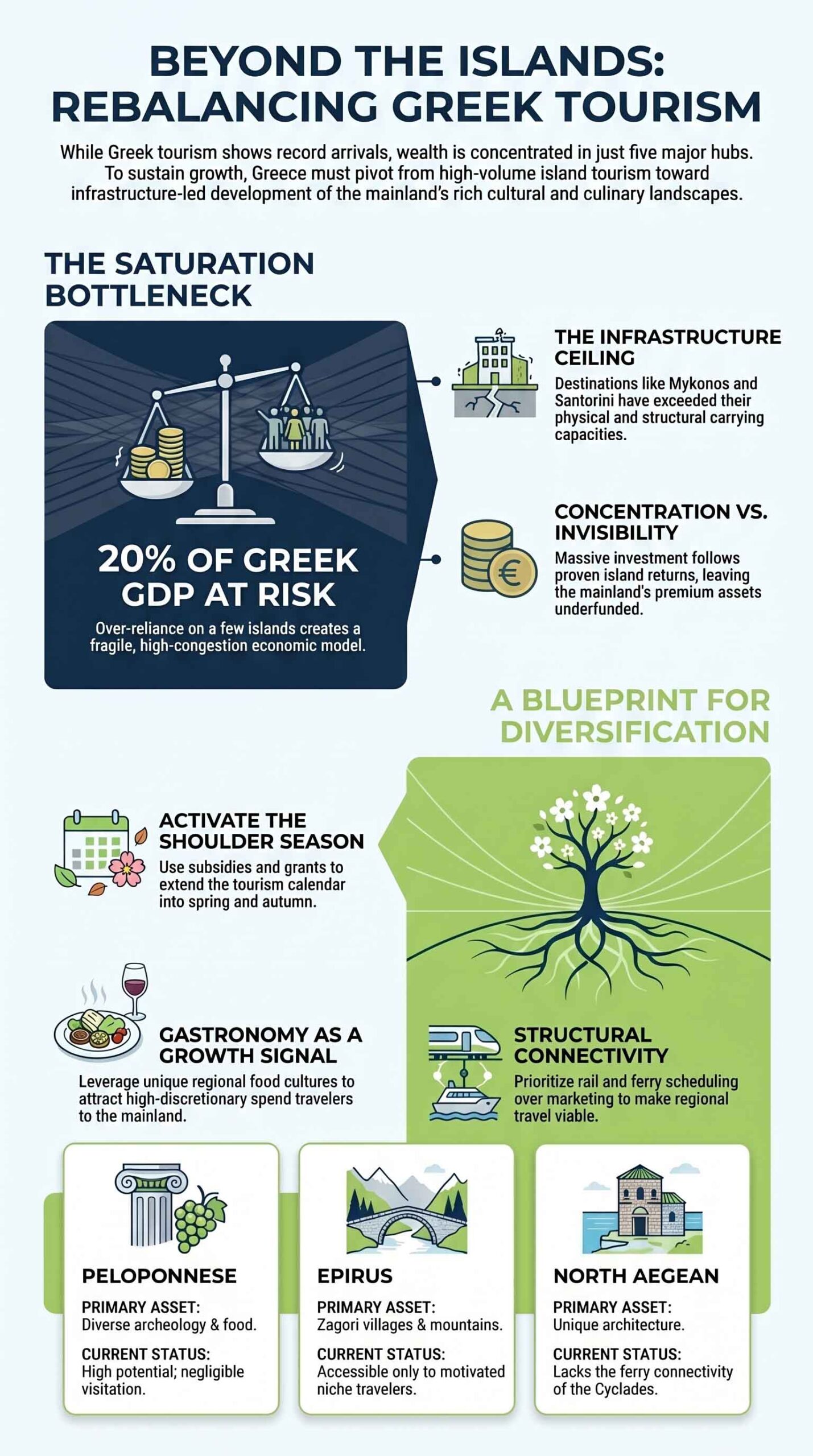
Greece’s tourism numbers look healthy on the surface: record arrivals, strong revenue, sustained international demand. The problem is not volume. It is a distribution. The overwhelming majority of international spend concentrates in Athens, Santorini, Mykonos, Rhodes, and the larger Cretan resorts. Everything else, which is most of the country, is largely invisible to international tourism, not because it lacks product but because no serious investment, policy, or infrastructure effort has been directed at developing it.
That model has a ceiling, and it’s now visible. Going beyond it, exploring Greece beyond the islands, is not a niche preference. It is the most coherent way to experience the country.
The Geography of the Problem
The Peloponnese contains Mystras, Monemvasia, the Mani, Nafplio, Olympia, and Epidaurus within a driveable circuit. Its food culture is among the most serious in Greece. International visitation is negligible relative to what the product warrants.
Epirus has mountain landscapes, Ottoman-era architecture in Ioannina, ancient Greek archaeological sites including Dodona (one of the oldest oracular sanctuaries in Greece, with a theatre in better condition than most), Kassope, (a well-preserved Hellenistic city with panoramic views over the Ambracian Gulf that receives almost no visitors) and Nicopolis (founded by Augustus after Actium, with Roman and early Christian layers spread across a large unwalled site), and the Zagori villages above the Vikos Gorge.
Thessaloniki is a functioning city with serious food, Byzantine and Ottoman layering, and a street culture that Athens has largely lost to tourism pressure and gentrification.
The north Aegean islands, Lesbos, Chios, and Samos, have architecture, gastronomy, and landscapes that the Cyclades cannot match, and a fraction of the visitors.
None of these is unknown in any absolute sense. They appear in guidebooks. They are known to Greeks, some Germans, serious walkers, and food-focused travelers. What they lack is infrastructure investment, ferry connectivity, and hospitality development that would make them accessible to international travelers who are not already motivated to seek them out.
That is a policy failure, not a market signal.
Why the Concentration Happened
The 2008-2015 financial crisis destroyed institutional capacity in Greece and redirected whatever public investment existed toward survival rather than development. The state’s ability to plan and execute regional tourism policy was already weak before the crisis. After it, the capacity became vestigial.
Private capital followed the proven return. Santorini and Mykonos attract investment because their margins are clear and demand is established. Nobody builds a serious hotel in Arcadia because the demand signal is not there yet, and creating it requires coordination that the Greek state has never been organized enough to provide.
Tourism represents roughly 20% of Greek GDP. Any government has strong short-term incentives to protect the existing model rather than reform it, because reform means disruption before it means improvement, and Greek electoral cycles do not reward that trade-off.
The result is a system that optimizes for throughput in a handful of places while leaving most of the country’s product underused.
What the Concentrated Destinations Are Actually Selling
Santorini and Mykonos are not without merit. The problem is not that they exist, but that, in international perception, they have become the totality of what Greece offers. And within them, the product has been tuned for throughput rather than experience.
Cruise ship day-trippers generate congestion and spend almost nothing on accommodation or serious food. The landing fees are insufficient deterrents. Mykonos has priced itself into a narrow luxury-and-party segment that is exposed to demand shifts and, increasingly, to reputational erosion when a destination’s primary association becomes its crowds rather than its character.
Athens is a separate case. It is increasingly expensive relative to what it delivers to a traveler not primarily interested in ancient history. The street-level culture that made it worth visiting beyond the Acropolis has been compressed by short-term rental saturation and the economic pressure that follows mass tourism into a city center.
These are not temporary conditions. They are structural.
What a Better Model Requires
This is not an argument for making Greece expensive. Price is not the variable. The French Riviera is expensive and still overrun. What makes a destination function well is not its price point but the integrity of the product: the food, the architecture, the landscape, and how well the infrastructure serves the experience. Greece has all of these in abundance in the right places. They are not improved by adding zeros to the room rate.
What the country actually needs is a structural reorientation of where investment goes, what behavior is permitted, and how the season is managed. Specifically:
Carrying capacity enforcement. Santorini’s cruise ship cap exists on paper and is routinely circumvented. Mykonos has no serious equivalent. Hard legal limits are basic asset protection. Physical infrastructure in these places was not built for current volumes. Continuing to exceed those limits degrades the product for every traveler, including those paying the highest prices.
Infrastructure investment in the mainland and northern Aegean. Marketing campaigns telling people to discover the Peloponnese will not work. Rail connectivity in northern and western Greece is inadequate beyond the Athens-Thessaloniki line. Ferry scheduling to smaller islands needs to operate on shoulder-season timetables that make multi-island itineraries viable outside July and August. Road access through Epirus and the central Peloponnese limits what travelers can reach, regardless of their interests. These are not glamorous investments. They are the ones that actually move people.
Shoulder-season activation. The Greek season is compressed to roughly four months, partly because infrastructure does not support extension and partly because operators have no incentive to open outside peak months. Targeted incentives, reduced licensing fees, energy subsidies, or direct grants for properties that operate in April, May, October, and November, would begin to change that calculus. EU structural funds for this purpose have existed and been underdeployed. That is a political failure, not a resource constraint.
Building regulation enforcement. Greece has had regulations protecting landscape character for decades. Enforcement has been selective. The visual degradation of accessible coastal areas, concrete construction without aesthetic control, density, and signage are direct costs to the product. Enforcing existing rules does not require new legislation.
Gastronomy as the primary regional signal. Greek food at its best is world-class by any serious standard. The Peloponnese, Crete, Thessaloniki, Epirus, and Chios: each has a distinct and serious food culture that the international market has barely registered. This is the correct axis on which to build visibility for the underdeveloped regions, because it speaks directly to the traveler with discretionary income and genuine curiosity, and because the product already exists. It needs access and attention, not artificial construction.
Greece Beyond the Islands: A Tourism Model That Works © in Love with the Med
The Traveler’s Position in All of This
Greece beyond the islands is not a theoretical proposition. It is now available in the places described above to any traveler willing to move beyond the established circuit.
The Mani in October is one of the most compelling landscapes in Europe: bone-dry, architecturally severe, with a food culture rooted in olive oil, cured meats, and legumes that bears no resemblance to tourist-circuit Greek food. Thessaloniki in spring is a functioning city with serious restaurants, Byzantine churches that receive a fraction of the attention of the Acropolis, and a market culture that rewards a slow morning. The Zagori villages in the north are organized around stone architecture and mountain walking, largely free of the seasonal saturation that defines the Aegean coast.
None of these requires a discovery narrative. They require a booking and a willingness to drive, or to take a ferry that runs less frequently than the one to Mykonos.
The broader structural argument, what Greece should do with its tourism policy, matters because it determines how long these places remain accessible in this condition. The country has an exceptional product. The question is whether it will manage it seriously enough to protect it. The current trajectory suggests not. The alternatives are clear enough, even if the political will to pursue them has not materialized.
For the traveler, the practical conclusion is this: the concentrated destinations in peak season are increasingly poor value at any price point. The rest of the country is not.
– The views expressed here reflect the editorial position of “in Love with the Med”.