For more than twenty years, one of the great battles in hospitality has been fought over a deceptively simple question:
Who owns the booking?
The hotel or the online travel agency?
Hotels invested heavily in websites, booking engines, loyalty programmes, Google advertising and direct-booking campaigns. Booking.com, Expedia and other platforms invested even more heavily in becoming the place where travellers searched, compared and eventually booked.
The argument was largely commercial. Commission versus acquisition cost. Direct booking versus OTA booking. Brand loyalty versus platform loyalty.
Artificial intelligence is about to move that argument somewhere much more fundamental.
Because the next question is not simply who receives the reservation.
It is:
Who decides which hotel the traveller sees in the first place?
And once AI begins making that decision, the hotel industry may discover that it has been fighting over the wrong part of the journey.
The traveller may no longer search for a hotel
Imagine a traveller planning ten days in southern Italy.
A few years ago, the process might have begun with Google:
best boutique hotels Puglia
Then came perhaps twenty tabs. TripAdvisor. Booking.com. Expedia. Hotel websites. Instagram. A travel magazine. Google Maps. Reviews. Rates. More reviews.
Eventually, a shortlist emerged.
Now consider a different conversation:
Find me a small, quiet hotel in Puglia for four nights in September. I want somewhere locally owned, close enough to walk to dinner, with a pool, excellent breakfast and no nightclub atmosphere. I do not want a large resort. I am happy to spend up to €450 per night if the hotel is exceptional.
The traveller has not searched.
The traveller has described an intention.
The AI does the searching.
That distinction matters enormously.
Google has already introduced increasingly sophisticated travel planning inside AI Mode and has said that hotel and flight booking capabilities will become part of that environment. OpenAI has introduced apps inside ChatGPT with travel companies including Booking.com and Expedia in supported markets. Booking.com itself has been developing AI-powered travel-planning products with OpenAI.
The travel interface is gradually changing from a search box into a conversation.
And conversations do not necessarily produce ten blue links.
They produce answers.
AI hotel recommendations create a new gatekeeper
This is where things become uncomfortable for hotels.
When somebody searches Google for “hotels in Amalfi”, the traveller can still see many competing properties.
When somebody asks an AI:
“Where should I stay on the Amalfi Coast if I want privacy, excellent food and somewhere that doesn’t feel overly touristy?”
the AI may mention five hotels.
Perhaps three.
Perhaps only one.
The battle for visibility therefore becomes considerably more concentrated.
A recent 2026 research preprint examining hotel recommendations across multiple large language models found that factors including guest ratings and price had substantial influence over which hotels the models selected. More intriguingly, even the position in which a property appeared within supplied information could influence the recommendation.
This should destroy the comforting assumption that artificial intelligence somehow represents a perfectly neutral travel adviser.
It does not.
AI systems make decisions from the information available to them, the sources they can access, the structure of those sources, the context of the question and the mechanisms by which they evaluate competing information.
The new hotel receptionist may still be human.
The new hotel gatekeeper may not be.
The OTAs are not disappearing
There is a wonderfully seductive theory circulating through hospitality: artificial intelligence will finally destroy the dominance of the OTAs.
Perhaps.
But there is another possibility.
AI may simply create a new layer above them.
Booking.com and Expedia have spent decades building something exceptionally valuable. Not merely websites, but enormous inventories of accommodation, rates, availability, photographs, reviews, booking histories and traveller behaviour.
That infrastructure is useful to AI.
Which explains why major travel platforms are already participating in AI ecosystems rather than standing outside them.
Google has been developing its AI travel experience with booking partners. ChatGPT has integrated travel apps including Booking.com and Expedia in supported markets. Hotel distribution technology companies are also beginning to make live hotel inventory available to AI-driven channels.
So the future may not be:
Hotel versus OTA.
It could become:
Hotel → OTA or distribution platform → AI → traveller.
That should concern every independent hotelier.
Because another intermediary has potentially entered the room.
So who actually “owns” the guest?
Nobody owns a guest.
A traveller is not inventory, and “ownership” here should never be interpreted literally or as ownership of somebody’s personal information.
What hotels can own, commercially speaking, is the relationship.
And there are now several distinct layers to that relationship:
- Discovery: Who introduced the hotel to the traveller?
- Decision: Who persuaded the traveller that this particular hotel was right?
- Transaction: Where was the reservation actually made?
- Relationship: With whom does the guest continue communicating, interacting and eventually booking again?
Historically, a hotel could lose discovery and transaction to an OTA but still recover some of the relationship once the guest walked through the door.
AI complicates this.
If an AI knows the traveller’s preferences, remembers previous trips, understands the budget, chooses the destination, recommends the hotel, compares rooms, helps make the reservation, suggests restaurants and later plans the next holiday, something extraordinary has happened.
The traveller’s primary travel relationship may no longer be with the hotel.
It may not even be with Booking.com.
It may be with the assistant.
That is the strategic question hospitality needs to start discussing.
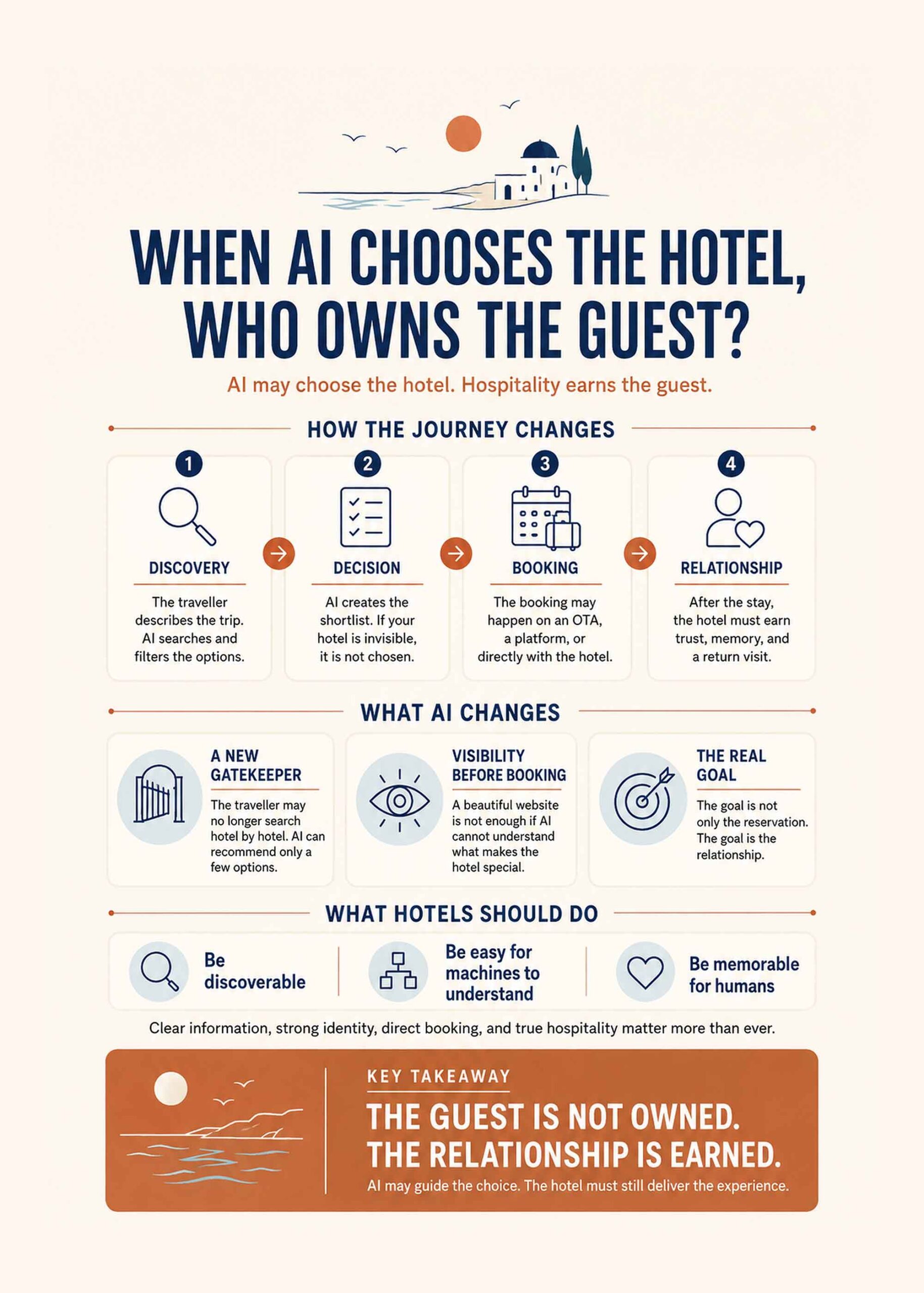
When AI Chooses the Hotel, Who Owns the Guest? © in Love with the Med
The real prize is not the reservation
Expedia Group’s own 2026 research illustrates how complicated this transition remains. Its study reported that nearly 70% of travellers surveyed still preferred completing bookings with trusted travel brands rather than AI chatbots or agents, even while travellers were becoming increasingly comfortable using AI during planning.
That is important.
But it would be a mistake for hotels to interpret it as evidence that little will change.
Trust takes time.
Twenty-five years ago, plenty of travellers were nervous about putting their credit card details into a website.
Today they book €5,000 holidays from a telephone while sitting in an airport lounge.
Behaviour changes when convenience becomes convincing enough.
The hotel industry should therefore look beyond the final booking button.
The greater prize is influence over the decision.
If the traveller asks an AI for five romantic hotels in Sicily, being one of those five may eventually matter considerably more than ranking fourth on a conventional Google results page.
And being absent may make everything else irrelevant.
Your beautiful website cannot convert a traveller who was never introduced to you.
AI could also weaken the old gatekeepers
There is, however, another side to this story, and independent hotels should pay close attention to it.
AI does not necessarily need to reproduce the OTA model.
A fascinating 2026 research preprint analysed more than 1,300 citations generated during hotel-related queries using Google Gemini. It found that when queries were experiential rather than transactional, the AI relied considerably more often on non-OTA sources.
That distinction could become extremely important.
Ask:
“Cheapest hotel in Florence next Tuesday.”
The problem is primarily transactional.
Rates, availability and location dominate.
Ask instead:
“Where should I stay in Florence if I love Renaissance architecture, dislike large luxury hotels and want to walk to small neighbourhood restaurants at night?”
Now we have context.
Editorial content matters.
Local expertise matters.
Hotel identity matters.
Independent sources matter.
The hotel’s own ability to explain itself matters.
AI could therefore strengthen the enormous platforms.
But it could simultaneously create opportunities for distinctive independent hotels that were previously buried underneath companies with far greater advertising budgets.
The outcome depends partly on whether those hotels understand what AI can actually discover about them.
Your hotel now has two audiences
For years, good hotel marketing focused almost entirely on humans.
Beautiful photography.
Atmospheric language.
Emotional storytelling.
Perhaps a cinematic video of curtains moving gently beside an infinity pool while somebody carries an espresso across a terrace.
All perfectly reasonable.
But the hotel website now has another visitor.
The machine.
And the machine needs clarity.
It needs to understand:
Where exactly is the hotel?
Is it independent?
How many rooms does it have?
Does it have a swimming pool?
Is the pool heated?
Can children stay?
Is the restaurant open to non-residents?
Does the hotel operate year-round?
How far is it from the beach?
Does it have parking?
What type of breakfast does it serve?
Which rooms have sea views?
What makes the property meaningfully different from fifty alternatives nearby?
A surprising number of beautiful hotel websites make these questions unnecessarily difficult to answer.
There may be 600 words about the sensation of Mediterranean light and almost nothing explaining whether the restaurant is actually open on Tuesday.
That was already bad digital marketing.
In an AI-mediated world, it becomes something worse.
It makes the hotel difficult to understand.
SEO is not disappearing. It is evolving.
There is already enormous excitement around GEO, Generative Engine Optimisation, the supposed successor to Search Engine Optimisation.
Some of it will inevitably become another marketing industry selling mysterious techniques to frightened hotel owners.
The principles need not be mysterious.
Generative optimisation should begin with something extraordinarily unfashionable:
Tell the truth clearly.
Make the hotel’s factual identity consistent.
Create useful original information.
Answer real traveller questions.
Maintain accurate structured information.
Make rooms, facilities, policies, location and experiences understandable.
Earn genuine coverage from credible third parties.
Give journalists, destination publications and travellers reasons to discuss the property beyond a copied press release.
Build a hotel brand with enough distinction that other people describe it without being paid to repeat your adjectives.
SEO still matters because search engines remain important.
Editorial coverage matters because AI systems consume and synthesise external information.
Reviews matter because reputation provides signals.
The hotel’s website matters because it should remain the canonical authority on the property.
The future is not SEO or AI optimisation.
It is digital authority.
The independent hotel faces a choice
Consider a forty-room Mediterranean hotel.
It can become one more piece of accommodation inventory distributed through whichever platforms dominate the next generation of travel technology.
Its rooms will be compared according to price, score, facilities and availability.
The AI will know that it has a pool, 8.9 reviews and breakfast included.
That is one future.
Or the hotel can become something considerably more difficult to commoditise.
A property with a clearly articulated identity.
A recognised relationship with its destination.
Original stories.
Authoritative information.
Distinctive food.
People travellers remember.
A website worth visiting.
A direct booking proposition worth choosing.
A reputation that exists independently of whichever intermediary happens to be displaying its rooms.
The second hotel still needs distribution.
It should still work with OTAs where commercially sensible.
It should still make itself accessible to emerging AI systems.
But it is not merely supplying bedrooms to someone else’s marketplace.
It is building an asset of its own.
A name.
The Mediterranean has something AI cannot manufacture
This matters particularly here.
The Mediterranean is full of hotels that would perform terribly if hospitality were reduced entirely to checkboxes.
A twelve-room hotel in Paxos may not have a spa.
A restored masseria in Puglia may not have twenty-four-hour room service.
A family-run inn in Epirus may have none of the amenities associated with an international luxury chain.
Yet one of them may give a traveller the best week of the year.
Hospitality has always contained qualities that are difficult to quantify.
Generosity.
Memory.
Taste.
Human judgement.
A sense of place.
Knowing when to appear and when to disappear.
Knowing that the guest who asked for coffee at six yesterday will probably want it at six today.
Knowing which little taverna is wonderful this week rather than which restaurant has accumulated the largest number of online reviews over ten years.
AI can describe those qualities.
It can increasingly identify evidence of them.
It may eventually become very good at matching them to the right traveller.
But it cannot create them on behalf of the hotel.
That remains the responsibility of hospitality.
The great danger is becoming invisible before the guest arrives
Hotels have spent years worrying about commission.
The next battle may be visibility.
An independent hotel could have a superb direct-booking strategy, excellent conversion rate and beautifully designed booking engine.
None of it matters if the traveller says:
“Find me the three hotels you think I would love most.”
And the hotel is not among them.
The strategic priority therefore changes.
Hotels must not merely ask:
“How do we persuade people to book direct?”
They must also ask:
“How does an intelligent system know that we are worth recommending?”
That question reaches far beyond technology.
It touches branding, public relations, distribution, reputation, content, website architecture, reviews, destination positioning and the actual guest experience.
Because AI can only build its understanding from signals that exist.
A hotel that has no clear digital identity risks allowing everybody else to define it.
Direct booking becomes more important, not less
There is a curious paradox here.
The easier AI makes discovery, the more valuable a direct relationship may become.
If AI introduces a traveller to the hotel and then sends that traveller directly to the hotel’s own environment to complete the reservation, AI could actually reduce dependency on traditional intermediaries.
Some emerging hotel technology initiatives are already being designed around AI access to live inventory combined with direct hotel booking pathways.
For independent hotels, that is the scenario worth fighting for.
Not a closed internet.
Not resistance to AI.
Not another hopeless attempt to force every traveller to begin on the hotel’s homepage.
Something much more practical:
Be discoverable everywhere. Be bookable directly. Be memorable afterwards.
Discovery can be distributed.
The relationship should not be.
And perhaps that is the answer
When AI chooses the hotel, who owns the guest?
Neither the AI.
Nor the OTA.
Nor, ultimately, the hotel.
The guest chooses whom to trust.
Technology may decide which properties appear on the shortlist. Platforms may facilitate the transaction. Algorithms may learn what kind of room, destination, breakfast or beach somebody prefers.
But after arrival, there is still a door that opens.
There is still somebody standing on the other side.
There is still a room that must be clean, a breakfast that must be good, a problem that must be solved and a welcome that must feel sincere.
That part has not changed.
And perhaps the hotels most likely to survive the age of artificial intelligence are not those that become most artificial.
They will be the hotels that make themselves easy for machines to understand and impossible for humans to forget.
AI may choose the hotel.
Hospitality still has to earn the guest.
The views expressed here reflect the editorial position of in Love with the Med.