The Greek car rental market operates on a single structural assumption: that you have already landed, you are standing in the arrivals hall, and the only practical way to reach the places you came to see is to hand your credit card to whoever is behind the counter. The industry has priced accordingly for decades. The result is a product that is more expensive, more restrictive, and more deliberately opaque than almost any comparable market in the European Union.
There is an alternative. It requires a slightly different plan. It is worth it.
The Tax Problem
Greece levies 24% VAT on car rentals. That is the highest standard rate in the EU, and it is baked into every quote, every comparison site result, and every seemingly reasonable daily rate you see. France charges 20%, Germany 19%, Bulgaria 20%, Italy 22%. The difference is not cosmetic: on a ten-day rental at a €40/day base rate, the Greek tax surcharge alone adds roughly €96 to what you would pay for an identical car rented in Germany.
This is before you get to the other costs.
The Deposit Problem
Major operators in Greece charge €290 to €390 for economy, compact, and midsize categories at pickup. Mid-tier and local companies frequently hold €500 to €1,000, and more for larger vehicles, in peak season. Physical credit card only: no prepaid card, no virtual card, no Revolut. That hold is released by your bank, not by the rental company, on whatever timeline your bank decides. Two to three weeks is normal.
The capital is frozen while you are on your trip and for an indeterminate period afterward. For travelers managing their finances carefully, this is a real cash-flow problem, not a minor inconvenience.
The Insurance Architecture
The standard CDW included in or offered alongside most Greek rentals does not cover the underside of the vehicle, the interior, windshields, mirrors, keys, incorrect fueling, wheels, or tires. To get to zero excess, you need a Super CDW or Full Damage Waiver on top, which costs an additional €8 to €20 per day, depending on the operator and vehicle class.
This matters specifically in Greece because the roads leading to the places worth visiting are exactly the conditions under which a rental car can pick up undercarriage scrapes, sidewall damage, and windshield chips. The Mani peninsula, the mountain villages of Crete, the back roads of Epirus, the unpaved tracks to isolated beaches: none of these is the motorway to Thessaloniki. The CDW protects you there. It does not protect you where you actually want to drive.
For a two-week rental, full damage waiver coverage adds €112 to €280 to the bill, on top of 24% VAT on a base rate already priced for captive demand.
The Ferry Problem
Greece is an archipelago. Using a rental car to explore it logically means putting the car on a ferry. The terms of most Greek rental agreements make this structurally difficult.
Sixt Greece states outright that cross-border rentals are not permitted. Europcar Greece voids CDW coverage for any damage that occurs during ferry transport unless prior written authorization was obtained at the time of pickup, not booked in advance online. If the car is scratched on the loading ramp, hit by another vehicle in the hold, or dented on the car deck during a crossing, you are personally liable for the full repair cost, regardless of what your insurance tier covers.
Permission for ferry transport can be obtained in advance at most major operators, but it requires a phone call or counter conversation, sometimes additional daily fees, and a specific endorsement on the rental agreement. It is not the default. And crucially, even with permission, coverage during the actual crossing is void at several operators. The car is insured in port and insured at your destination. The time in between is your problem.
The Cross-Border Reality
This is the clearest evidence of how the Greek rental market views its customers.
Sixt Greece prohibits cross-border rentals entirely. Several smaller operators state in their terms that the vehicle is not permitted outside the country’s borders without qualification. The larger international operators who do allow it, including Hertz, require at least five days’ advance notice before pickup and charge additional fees for the privilege. Enterprise Greece limits cross-border travel to EU countries only, which eliminates Albania, North Macedonia, and Turkey.
The practical result: a car rented in Greece is a closed system. You cannot drive it into any of the four countries that share a land border with Greece without researching, negotiating, and paying extra. You cannot take it onto a ferry without specific advance authorization. You cannot, in most cases, insure it against the road conditions that define the most interesting parts of the country.
Compare this with standard EU practice. In most Western European markets, cross-border travel within the Schengen Area is permitted with advance notification and, in some cases, a small fee. The restriction-as-default model is a market-specific choice, not a regulatory requirement.
The Better Option: Rent in Bulgaria
Bulgaria shares a land border with Greece. The crossing at Kulata/Promachonas puts you in Thessaloniki in under three hours from the Sofia city center. From Thessaloniki, the entire northern Greek mainland is accessible: Halkidiki, Kavala, the Prespes lakes, the Via Egnatia corridor, and the ferry ports for the northeastern Aegean islands.
Enterprise Bulgaria explicitly permits cross-border travel to Greece, charging €6 per day, plus a one-time €60 green card fee. Top Rent A Car Bulgaria lists Greece as a standard cross-border destination selectable at the booking stage, with a flat administrative fee and the option to purchase premium protection instead of paying double the deposit. Local Bulgarian operators have a documented history of multi-country Balkan road trips for international clients, with established paperwork procedures at the Greek border.
Bulgaria’s VAT on rentals is 20%, not 24%. Base daily rates for equivalent vehicles run 20 to 35% lower than Greek high-season prices. The deposit structures are lower. Cross-border into Greece is not an exception requiring negotiation: it is a documented, standard product.
Fly into Sofia. Collect the car. Drive south. The route through the Rhodope Mountains before the border is not a detour: it is a reason to come early.
The Italy Option (With Caveats)
Ferries run from Bari, Brindisi, and Ancona to Patras and Igoumenitsa, making Italy a logical starting point for anyone combining southern Italy and Greece in a single itinerary. An Italian-registered vehicle enters Greece without restriction, and Italy’s wider EU cross-border framework is more permissive than Greece’s.
The complication is the rental car itself. Taking a third-party rental vehicle onto a ferry requires explicit written authorization from the operator, and several major companies, including Hertz, void insurance during ferry transport regardless of the country pair involved. Finding an Italian operator who covers the crossing, allows travel into Greece, and extends that coverage for the duration of the Greek leg requires deliberate company selection and advance coordination. It is not a casual decision.
For travelers already planning Italy as the first leg of their itinerary, it is worth pursuing. Sixt Italy and some local Italian operators can accommodate it with advance notice. The key is to confirm in writing, before you sign the rental agreement, that the vehicle is covered during the ferry crossing and in Greece for the intended rental period. Do not assume either condition.
What This Means in Practice
If your trip is Greece-only, with no intention of crossing into a neighboring country, the Bulgarian rental option still makes sense for anyone arriving in Thessaloniki or planning a mainland itinerary. For island-centric trips based out of Athens, the geography makes the Bulgarian option less convenient, and you are back to working within the Greek market. In that case: a physical credit card with a high available balance, a full damage waiver purchased in advance online at a lower rate than at the counter, authorization for any ferry transport confirmed in writing at pickup, and photographs of every surface of the vehicle before you leave the lot.
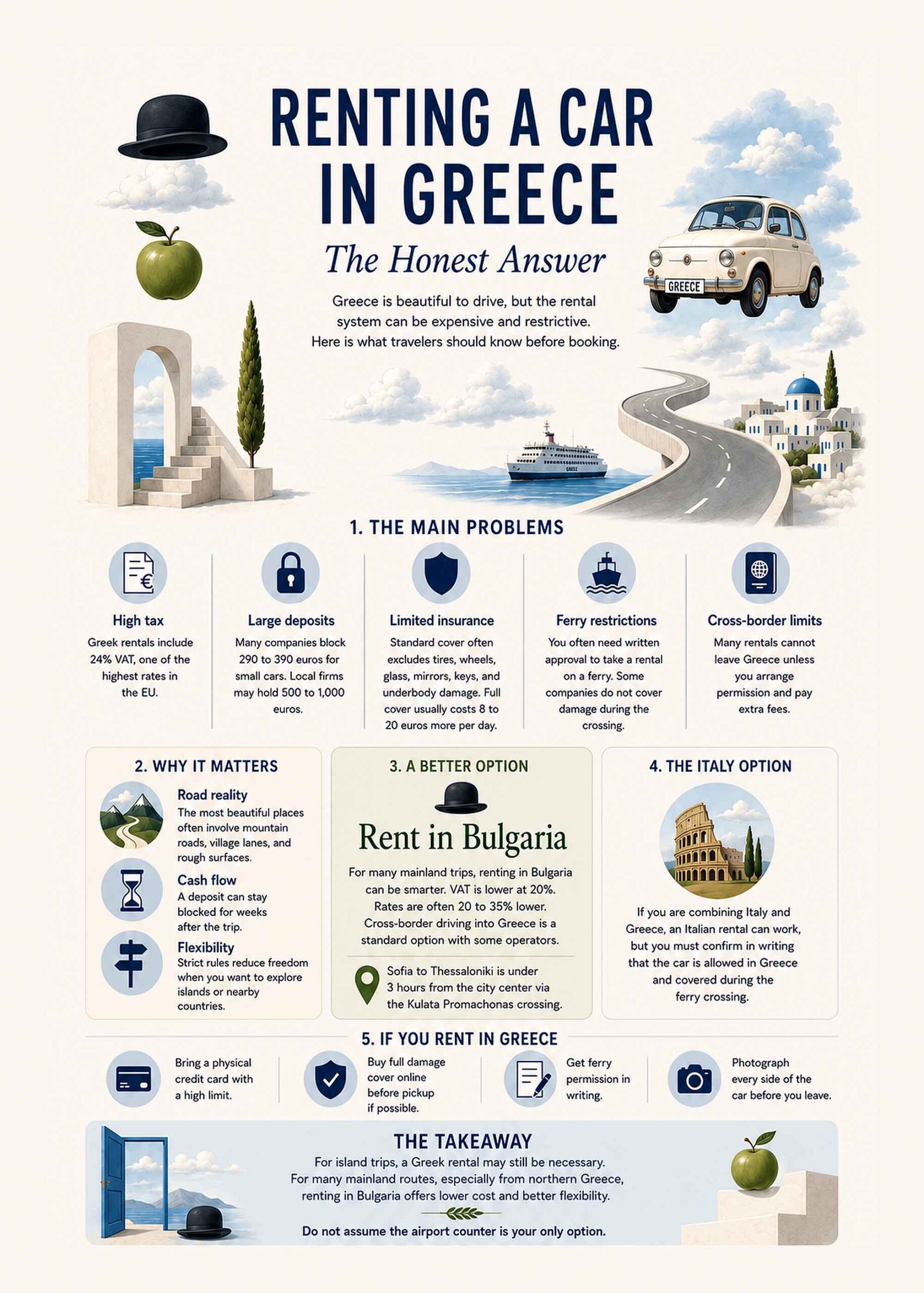
Should You Rent a Car in Greece? The Honest Answer © in Love with the Med
For anyone building an itinerary that combines Greece with the western Balkans or the Adriatic, the case for avoiding Greek rental entirely is unambiguous. Rent in Bulgaria, pay less, carry more flexibility, and drive south.
The Greek car rental industry has been allowed to price for captive demand because most visitors assume they have no choice. They do.
Affiliate Disclaimer: At “in Love with the Med”, we participate in various affiliate marketing programs, which means we may earn a commission if you make a purchase through our affiliate links. We only promote products and services that we believe will be beneficial to our readers and that we have personally used or researched.