Both islands appear on every Cyclades shortlist. They are not interchangeable. Paros and Naxos sit close together on the map and differ in character about as much as Athens differs from Thessaloniki. The confusion comes from the fact that both offer good beaches, decent food, and reliable ferry connections. So does every inhabited island in the Aegean. The question is what else you want, and the answer to that determines which island is yours.
What Paros Does Well
Start with Naoussa, because Naoussa is the reason most people fall in love with Paros. The village sits on a small natural harbor in the north of the island, built around the ruins of a Venetian castle and lined with whitewashed buildings so close together the alleyways feel almost theatrical. It is small, beautiful, and has exactly the right amount of evening life: enough to feel alive, not so much that it stops being a village. The seafood restaurants along the harbor are reliable, and the local catch is handled simply because it does not need anything else.
Parikia, the main port, is less immediately charming but worth a morning. The Panagia Ekatontapiliani, known as the Church of 100 Doors, is one of the oldest surviving Byzantine churches in Greece and is consistently overlooked in favor of the beaches. The old town immediately behind the port has the maze-like quality common to Cycladic settlements and functions as a proper neighborhood rather than just a tourist corridor.
The beaches on Paros are good, but not exceptional. Golden Beach on the east coast is well-organized and suits people who want facilities and windsurfing. Santa Maria in the northeast is more relaxed. Kolymbithres, north of Naoussa, features distinctive rock formations and calm waters, making it suitable for families with young children. None of them is a reason to choose Paros over Naxos. The port town is.
Paros also has a logistical advantage worth stating clearly: it is the Cyclades’ central ferry hub. If you are island-hopping, Paros sits at the intersection of multiple routes, making onward connections considerably easier than on Naxos. For anyone building a multi-island itinerary, this matters.
Paros suits: Couples looking for a romantic base with enough evening life to feel like a real destination. Travelers who want the Cycladic experience without needing to hire a car (a scooter or ATV covers the island adequately). Anyone using a central island as an island-hopping base. People who are primarily there for a port town and nearby beaches.
If you need the island to reward extended exploration, Paros will feel small by day three. That is not a criticism. It is useful information.
What Naxos Does Well
Naxos is the largest of the Cyclades, and its scale fundamentally changes the experience. Where Paros is a collection of excellent parts within easy reach of each other, Naxos is an island that requires, and rewards, genuine exploration.
Naxos Town is the obvious starting point. The Portara, a marble doorway from an unfinished Temple of Apollo standing alone on the promontory at the entrance to the harbor, is more arresting in person than in photographs. The medieval Kastro above the town, built by the Venetian Marco Sanudo in the 13th century, is still partially inhabited and contains one of the most intact examples of Venetian urban planning in the Aegean. Below it, the market street that runs from the port into the old town rewards several hours of unhurried time.
The interior of Naxos is where the island separates itself from every other Cycladic island. Apeiranthos, a village in the eastern mountains, is paved with marble and has a fiercer, more austere character than anything on the coast. The residents speak a dialect distinct from standard Greek and, in our experience, have a reputation for not showing warmth to visitors. The village is better for it. Halki, in the central valley, is home to the Vallindras distillery, where kitron liqueur made from citron fruit has been produced since the 19th century and can be tasted and purchased directly on site. Filoti sits at the foot of Mount Zas, the highest peak in the Cyclades, and the walk to the summit and back is one of the better half-day hikes in the Aegean.
These are not peripheral attractions. They are the point of choosing Naxos over Paros.
The food makes a separate case. Naxian graviera is one of the better cheeses produced in Greece. The local potatoes, grown in volcanic soil, are genuinely exceptional and appear on menus across the island, not because it is fashionable but because they are good. The seafood is reliable everywhere in the Cyclades, but on Naxos, the quality of the food extends into the villages and remains there. You eat better on Naxos than almost anywhere else in the Cyclades, for less money.
The beaches are extensive. Agios Prokopios and Agia Anna, closest to Naxos Town, are good and appropriately busy in summer. Plaka, further south along the west coast, is a long arc of sand that remains relatively undeveloped even in August, which is unusual for a beach of that quality in the Cyclades. The sheer number of beaches means that when Paros feels crowded in peak summer, Naxos disperses its visitors more effectively.
Naxos suits: Families (the beaches are excellent, the island is large enough that August is survivable, and there is enough variety to keep people with different interests occupied for a week). People who care seriously about food. Hikers. Anyone for whom the island itself is the destination rather than a backdrop. Travelers who are willing to hire a car and use it properly.
That last point is not a minor caveat. Naxos without a car is a significantly reduced version of Naxos. The interior is inaccessible by bus in any meaningful way. If you do not hire a car, you are paying for an island you will not see.
Getting There
Both islands are served by Blue Star Ferries and SeaJets from Piraeus. The conventional ferry from Piraeus to Paros takes approximately 5 hours; the high-speed service cuts this to around 3 hours. Naxos is the next major stop on most routes, adding roughly 30 to 45 minutes to the journey.
If you are arriving from Mykonos or Santorini, both islands are reachable by fast ferry in under two hours. Paros is slightly more convenient for connections from Mykonos; Naxos is slightly more convenient for connections from Santorini.
Both islands have small airports with domestic connections to Athens, operated by Olympic Air and Sky Express. Neither has direct international flights. Most visitors fly into Athens and continue by ferry.
Getting Around
Paros is manageable on a scooter or ATV. A car gives more flexibility, but is not essential for covering the main areas of the island.
Naxos requires a car. There is no practical way to access the interior by public transport, and the coastal road south from Naxos Town to Pyrgaki traverses terrain that no scheduled bus reliably serves. Factor the rental cost into your accommodation budget.
Before proceeding, read this article carefully: Should You Rent a Car in Greece? The Honest Answer
Cost and Season
Naxos is consistently a better value. Accommodation costs less than comparable rooms on Paros. Restaurant prices are lower, and the food quality is higher. In August, Naoussa prices itself at a premium that reflects its reputation rather than any additional service. Naxos in the same period is noticeably more affordable.
Both islands are at their best in June and September. The crowds are manageable, the sea is warm, and the islands are fully operational without the compression of peak summer. May and October work well for travelers who do not need every restaurant to be open and who want a quieter, less expensive version of each island.
July and August on Paros, particularly in Naoussa, are genuinely crowded. On Naxos, the island’s scale allows it to absorb the same volume of visitors more effectively.
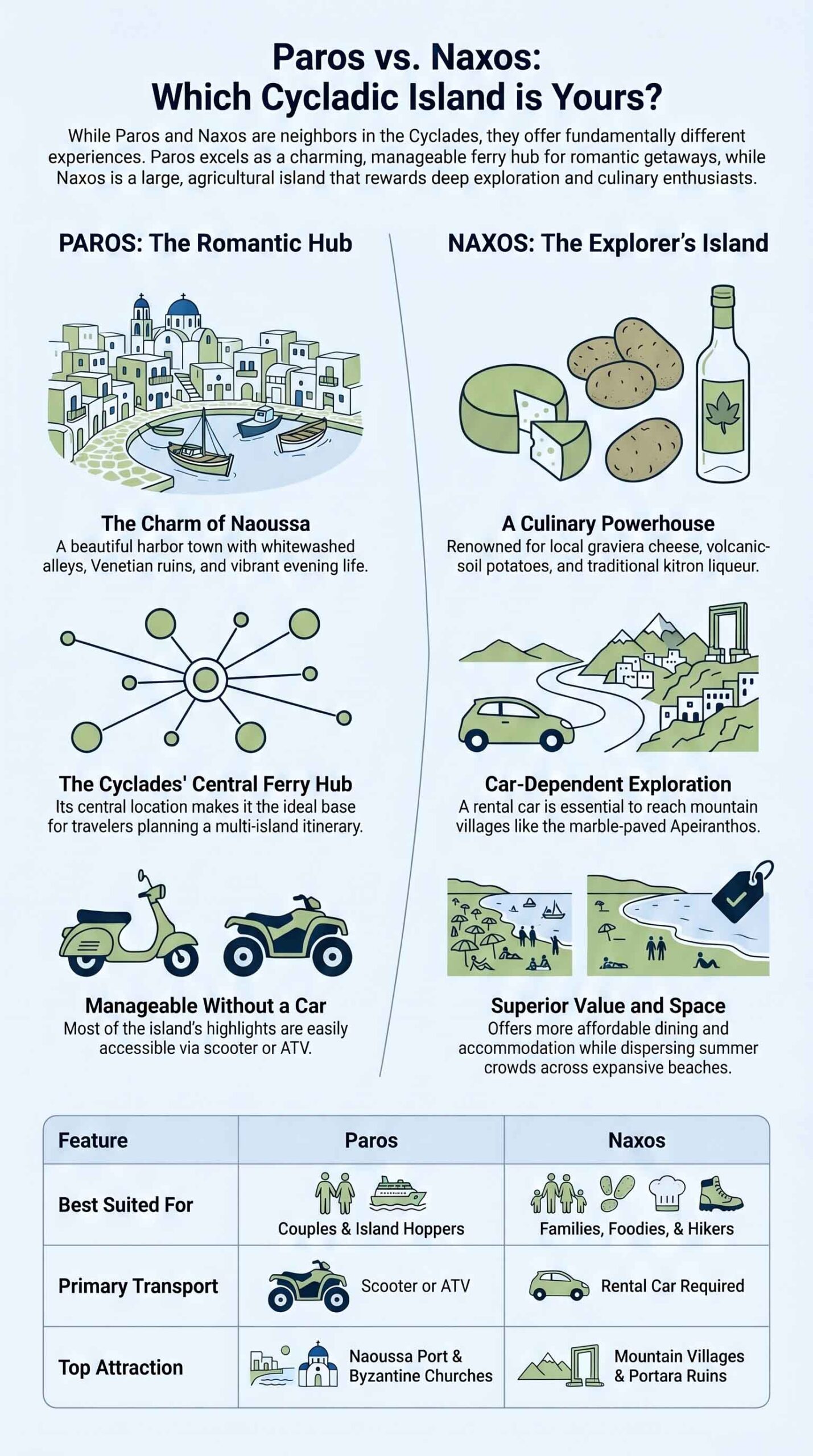
Paros or Naxos © in Love with the Med
The Short Version
If you want a beautiful port town as a base, a proportionate evening life, and ease of movement between islands, Paros is the answer. If you want the best food in the Cyclades, an island large enough to require a week of proper exploration, and an interior that most visitors to the Aegean never see, Naxos is the answer.
They share a latitude and a ferry route and appear on the same shortlists. They are not the same trip.
– If you are weighing whether to go to Mykonos at all before looking at alternatives, read The Verdict: Mykonos
– For everything else on the Cyclades: The Cyclades
Affiliate Disclaimer: At “in Love with the Med”, we participate in various affiliate marketing programs, which means we may earn a commission if you make a purchase through our affiliate links. We only promote products and services that we believe will be beneficial to our readers and that we have personally used or researched.